Sunday, 19 April 2015

Asian Electoral Stakeholder forum discusses electoral integrity in Asia and beyond

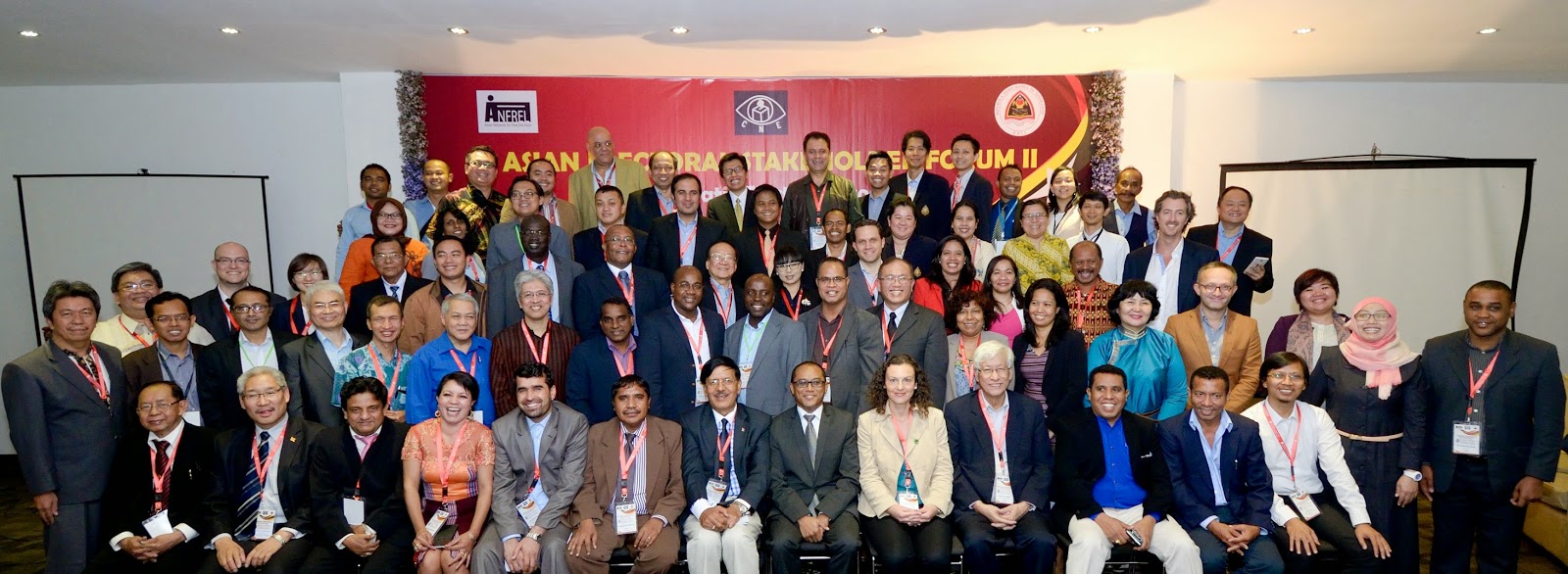
The second Asian Electoral Stakeholder Forum, 18-19 March 2015, Dili, Timor-Leste

With recent elections in Asia having drawn some unfavorable media attention (see for instance reporting on Thailand, Afghanistan, or Bangladesh), the Asian Network for Free Elections (ANFREL), and the Comissão Nacional de Eleições (CNE) of Timor-Leste hosted the Second Asian Electoral Stakeholder Forum on 18-19 March 2015 in Dili, Timor-Leste. The forum brought together an eclectic group of electoral management bodies and civil society organizations from throughout the region, as well as participants from international assistance providers such as the International Foundation for Electoral Systems (IFES), The Asia Foundation, and the National Endowment for Democracy (NED).

Esteemed leaders of Timor-Leste’s young democracy joined the forum, with the nation’s President José Maria Vasconcelos, Nobel Laureate Dr. Jose Ramos-Jorta, Founder of the State Dr. Marí Bim Hamude Alkatir, and the country’s first president and Founder of the State Kay Rala Xanana Gusmão each sharing their observations about the challenges of nation building, democratic institutions, and development.

One of the primary aims of the forum was the discussion and development of the ‘Dili Indicators for Democratic Elections’. Drawing on the 2012 Bangkok Declaration for Free and Fair Elections and broader international standards such as the UDHR and ICCPR, these indicators are part of the move towards enshrining norms of electoral integrity in regionally negotiated frameworks. The Dili Indicators recognize the importance of the whole electoral cycle, from a sound legal framework, a level playing field in terms of boundary delimitation, campaign finance, and media coverage, to professional electoral management, and inclusive and meaningful participation of citizens. Content-wise, the indicators are closely aligned with cross-regional instances of norm entrepreneurship, such as the Venice Commission, or the Declaration of Global Principles for Nonpartisan Election Observation and Monitoring by Citizen Organizations. 

While state-driven regional networks such as the Association of Asian Election Authorities might arguably extend a stronger claim of legitimacy for their norm entrepreneurship, both the Bangkok Declaration and the Dili Indicators are pushing norms in an innovative way through the joint deliberation and endorsement by electoral management bodies and civil society groups. The forum also deliberated whether regional norms should provide space for local practices such as the Noken voting system in parts of Papua – a topic controversially discussed elsewhere (see here, and here) – or whether norms of electoral integrity should be universal. Different views persisted, highlighting the ongoing debate around the normative framework of electoral integrity.

-------------------------------------------------------

Rohana Hettiarachchi, Executive Director of PAFFREL, addresses the panel, with representatives of the election commissions of (L-R) Cape Verde, Angola, and São Tomé and Príncipe listening closely.

Several members of the Community of Portuguese Speaking Countries (CPLP) attended the stakeholder forum upon invitation by the Timorese election commission. Speakers from Portugal, Angola, and Mozambique highlighted diverse challenges in their respective countries. Attending CPLP participants also moved forward with the Dili Declaration, initiated by the Timorese commission. The signatories - the EMBs of Angola, Cape Verde, Guinea-Bissau, Mozambique, São Tome & Principe, and Timor-Leste - committed to principles of universal, equal, free and direct suffrage. They agreed to establish a working group on best practices and dialogue with stakeholders, and to build a database for election data sharing in lusophone countries.

Nobel Laureate Dr. Jose Ramos-Jorta lauded Timor-Leste's electoral assistance to Guinea-Bissau as a positive example of South-South cooperation. The Timorese commission had helped the West African country with the logistics of voter registration and other issues of electoral administration in its May 2014 election.

-------------------------------------------------------

As representative of the EIP I discussed the findings of our annual report ‘The Year in Elections, 2014’. While pointing out problems of electoral integrity in a range of Asian countries, in particular Southeast Asia, positive developments were also highlighted in the panel discussion, such as the peaceful turnover or the Presidency in Sri Lanka, or high levels of electoral integrity in other third wave democracies such as Mongolia.

The joining panelists discussed challenges of electoral integrity in their respective countries. The U Aung Myint, election commissioner from Myanmar recounted his country's preparation for the election in late October/early November 2015. Holding the first broadly competitive election since 1990 in a climate of rapid socio-economic change, remaining areas of armed conflict, and anti-Muslim violence present a challenge for the Union Election Commission.. The upcoming polls will serve as a test for the country’s fledgling electoral institutions. 

Commissioner Fawzy vividly stressed the challenges of holding elections in a situation of ongoing insurgency in Afghanistan. The country scored among the five 'worst' elections of 2014 in the PEI Index, partly due to stark allegations of electoral fraud and the following complete audit. Electoral security was highlighted as the country’s main concern – a topic on which the Independent Election Commission had previously engaged with the Electoral Integrity Project and UNDP during the Secure and Fair Elections (SAFE) workshop in September 2014. 

Pakit Prommayon, Deputy Director-General for Electoral R&D of the Election Commission of Thailand (ECT), highlighted his institutions struggles of dealing with violent anti-election protests in the run-up to the February 2014 election. He made reference to the EIP annual report which had drawn some media attention in Thailand due to its low ranking of the country's electoral authorities and their handling of the results announcement. Khun Pakit stressed that Thailand's overall score in the PEI Index locates the country in the midddle range of countries - well above several other Southeast Asian neighbors. The ECT had previously refuted the results of the survey. 

L-R: Bidhayak Das (ANFREL), Hon. U Aung Myint (Union Election Commission of Myanmar), Com. Kwaja Aminullah Fawzy (IEC Afghanistan), Pakit Prommayon (Election Commission of Thailand), Com. Dasho Kunzang Wangdi (Election Commission of Bhutan), Adilur Rahman Khan (ODHIKAR), Max Grömping (Electoral Integrity Project)

Commissioner Dasho Kunzang Wangdi of Bhutan presented electoral activities undertaken in the mountainous South Asian country. Although the youngest EMB in the region, the Bhutanese commission conducts a host of voter education and mobilization activities, and foreign observers have often lauded the country for its peaceful transition to an electoral regime. Bhutan scored 68 out of 100 in the PEI Index, placing the country at the top of South Asia in terms of electoral integrity.

The challenges of electoral integrity in Bangladesh were recounted by leading civil society figure Adilur Rahman Khan, chairperson of the human rights organizations ODHIKAR. Khan - himself previously incarcerated for his work as a human rights defender – remarked in a somber tone on the fact that 153 out of 300 seats were won uncontested by the ruling party in his country’s latest election. He argued in favor of a caretaker government, able to see through the next national election in order to prevent a repetition of widespread violence and fraud in the next polls. 

-------------------------------------------------------

In sum, ANFREL and the CNE did a tremendous job bringing together such a diverse group of participants. In particular, the effort of bridging the gap between EMBs and civil society is very worthwhile, as other observers noted as well. The ongoing debate on regional standards, best practices and lessons learned will hopefully draw in the participation of more state bodies in future iterations of the Forum. Several intriguing opportunities for deeper engagement resulted from this meeting for the Electoral Integrity Project. These will be reported in due time on this very blogspot.

Max Grömping

Sydney, 20 April 2015

Max Grömping is a researcher for the Electoral Integrity Project at the University of Sydney. His current research focuses on the impact of social media and domestic observers on electoral integrity. Prior to this, he lectured at Thammasat University, Thailand. 


Contact: max.groemping[at]sydney.edu.au

Tuesday, 7 April 2015

Do regulations strengthen the integrity of campaign finance?

by Marcus Spittler
[marcus.spittler@wzb.eu]


Everybody is familiar with some major funding scandals in the headlines, as exemplified by Watergate, the impeachment of Brazil’s President Collor de Melo following accusations of corruption, or the UK Ecclestone affair. Concern has sparked initiatives like Money, Politics and Transparency project designed to encourage the public to “follow the money”.

Concern is well justified. The Perceptions of Electoral Integrity (PEI) index, a worldwide expert survey, has shown that campaign financing is regarded as the most problematic stage in the electoral cycle. This remains true for both long established democracies like America, as well as full-fledged autocracies like Belarus.

To mitigate problems arising with campaign financing, countries have implemented various policies, including disclosure and transparency requirements, contribution caps, spending limits, and public funding. The general expectation is that these regulations make elections fairer for parties and candidates without well-to-do donors. 

But in a comparative perspective, do regulations on campaign finance really bolster the integrity of elections?

New evidence suggests that they do -- under certain circumstances. In PEI experts were asked to assess the quality of all stages within the electoral cycle, including campaign finance, such as any problems arising from the misuse of state resources, the equitable access to public money. and the transparency of campaign finance. 

International IDEA, another intergovernmental organization providing electoral assistance, collects evidence about the regulation of campaign finance in countries worldwide. This includes: Monetary limits on donations and spending, bans of certain donor groups and reporting obligations of both candidates and parties. Besides the influence of public subsidies, IDEA thus covers all aspects of campaign financing. Theoretically all these regulations can be expected to have a positive influence on the fairness of campaign spending. To develop a measure of campaign finance regulations, the number of existing regulations per country can be summed.[1] The assumption behind this measurement is, as more the campaign financing process is regulated and constrained by law, as higher the chance for a fair electoral environment.

Source: Electoral Integrity Project 2015. The expert survey of Perceptions of Electoral Integrity, Release 3 (PEI-3) and IDEA.

The results are quite surprising and some of them are shown in the graph. More regulations have an influence on the electoral fairness. But while the effect is rather low in autocracies and democracies, regulations can have a strong impact on Hybrid Regimes, coded by Freedom House as “partly-free”, which provide certain liberties and competitive elections, but malfunction in other regards. Kuwait, Turkey, and the Ukraine are in this group.

The graph above shows the link between campaign regulations and financial integrity in these countries. The PEI Campaign Finance Index is drawn on the horizontal x-axis. The vertical y-axis indicates the amount of regulations, while the rising blue line shows us the effect of regulations on financial integrity. The points in the chart show the actual position of a country. For instance, the state of Moldova, deeply involved in border issues in its east and far from being a democracy, is perceived to have very fair campaign financing, while it strongly regulates campaign financing. The opposite is true for Malawi. Here regulations are low, as well as fairness in campaign financing.

What are the lessons? Regulations can make a difference -- especially in hybrid regimes. In autocracies they are less effective, because the regimes tend to abuse campaign finance regulations as a tool to suppress opposition parties. In democracies, laws seem to be insufficient to strengthen campaign finance integrity. Effective regulations are accompanied by other factors, including an electoral monitoring body which is capable of enforcing the laws, and a political culture where access to public money is distributed on an egalitarian basis and corruption is restricted.


[1] Since there is no assumption whether spending limits are more or less important than reporting commitments, the aggregates are not weighted.

Thursday, 2 April 2015

A gender gap in leadership performance?


Pippa Norris
(Harvard and Sydney Universities)

One of the most striking images of the first televised UK general election leadership debate on Thursday 2nd April 2015 was the comparison of the seven party leaders on the platform including three women: Nicola Sturgeon (SNP), Natalie Bennett (Green), and  Leanne Wood (Plaid Cymru).

The flash opinion polls immediately after the debate asking the public who won were divided, with YouGov putting Nicola Sturgeon first, while the Guardian/ICM Unlimited survey reported that Miliband and Cameron were neck-and-neck.

One question arising is whether the sex of the leaders had any impact on how women and men evaluated the leaders’ performance?

Do women voters lean in towards women leaders?

Graph 1 shows the breakdown from the Guardian/ ICM Unlimited poll of whether the leaders were seen by women and men to have performed either ‘very well’ or ‘quite well’.  The gender gap can be calculated as the difference in women and men’s performance evaluations.

Graph 1: Leaders performed 'well' or 'very well' by sex


Ref: The Guardian/ICM Unlimited Flash Poll 30 Mar-2 Apr 2015 N. 1,372

Thus compared with women, men favored the performance of two male leaders: Nigel Farange (by a substantial 9 points) and Nick Clegg (by 4 points). Greater support among men for UKIP was consistent with broader gender gaps in support for radical right-wing parties found throughout previous British and European research.

By contrast, women favored the performance of the three women leaders: Wood (by a substantial 11 points, the largest gender gap recorded in the survey), Bennett (by 9 points) and Sturgeon (by 5 points).

For the two major leaders – Ed Miliband and David Cameron – there was no significant gender gap in judgments about their performance.

Gender gaps in voting intentions?

But of course any gender gap could be produced by underlying patterns of party support rather than by the sex of the leaders per se, for example if women generally preferred the nationalist parties or those on the left of British politics.  A gender gap where women voters are more leftwing has been reported in many OECD countries in recent years, reflecting the pattern common in the United States since the early-1980s. To check this pattern, Graph 2 compares voting intentions for men and women in the same survey.

Graph 2: Voting intentions by Sex


Ref: The Guardian/ICM Unlimited Flash Poll 30 Mar-2 Apr 2015 N. 1,372

The results confirm that men are indeed more likely to express voting support for UKIP – producing a 5 point gender gap. But the gap was greater by UKIP leadership performance rather than voting intention.

By contrast, there is no significant gender gap reported for Plaid Cymru or the Scottish National Party, and only a small (2 point) gender gap where women are more inclined towards voting Green. The largest gender gap in voting intentions (4-points) is women’s greater support for the Labour party, while no significant gender gap can be observed in judgments of Miliband’s performance.

Gender matters in leadership evaluations

Thus the comparison based on the Guardian/ICM Unlimited flash poll suggest that the gender gap in evaluations of leadership performance during the British election debate were influenced by the sex of the leaders; this gap was not simply the result of prior party preferences.

The performance of the women party leaders (Bennett, Wood and Sturgeon) connected more favorably with women voters,  and this was not simply the product of existing gender gaps in party support.  By contrast,  men greatly favored the performance of Farange, and the gender gap here was larger than in voting support for UKIP.

In short, in British politics today, the survey evidence indicates that sex matters for political leadership.  It probably does so by providing a cognitive short-cut – especially for judging less well-known leaders for minor parties where people are relatively unfamiliar with their background, experience or policies.

One possible implication for British politics is that if Labour had selected a woman party leader instead of Ed Miliband, they could possibly have capitalized and potentially expanded their modest 4-point lead among women voters. Since there are more women than men voters in the electorate, this could have made all the difference for party fortunes in the close contest. There may be some lessons here for future leadership choices in Britain. Whether there are similar implications for other countries, including the potential capacity of Hilary Clinton to reinforce women’s support for the Democratic party, remains to be determined.

Pippa Norris is Professor of Government and International Relations at the University of Sydney, the Maguire Lecturer in Comparative Politics at Harvard’s Kennedy School of Government, and Director of the Electoral Integrity Project.


Saturday, 28 March 2015


Tunisia and Egypt: contrasting elections following the Arab Spring


Carla Luis   [carlaluis@ces.uc.pt]


What does it take to have a good election? This not a simple question and neither are the answers. The most common words to describe good elections, in most of the observation reports, always mention the well know expression “full, free and fair”. But what does this tell us and how can we decompose these factors?

Since 2012 the Electoral Integrity Project has assessed all national elections around the world, creating the Perceptions of Electoral Integrity index according to the ratings of electoral experts. The PEI assesses eleven main aspects, according to a division of the electoral cycle: electoral laws, electoral procedures, voter registration, party and candidate registration, media coverage, campaign finance, voting process, vote count, vote results and electoral authorities. 

In the latest EIP Year in Elections annual report, two countries are highlighted as clear contrasts: Egypt and Tunisia. Egypt had Presidential elections in May 2014. Tunisia had legislative elections in October 2014 and presidential contests in December 2014. Tunisia scores high in the PEI index, with its parliamentary contest ranking as the 25th best election in the world, whereas Egypt is one of the countries that “raised more red flags”. In fact, Egypt ranked 117th on a total of 127 countries, achieving a total of 48 points on the PEI 100-point scale.   

What can we conclude from this? First of all, in some categories both countries score relatively poorly: media coverage and campaign finance. As a general pattern, this was reported as a problem worldwide that needs to be addressed.

Party and candidate registration, as well party competition enshrined in the electoral laws, are areas where the two countries differ. In Egypt, some candidates were prevented from running, only top party leaders selected candidates, and some parties were restricted from carrying rallies. Egyptian legal provisions for party competition were unfair, limiting smaller parties and favoring the incumbent. Women did not have equal opportunities to run for office, the same for minorities.

As a sharp contrast, the PEI experts perceived Tunisian women as having fewer obstacles to run for office. Additionally, the current percentage of women in the Tunisian parliament is now 31% (68 out of 217 seats), ranking 31st according to the IPU. In 2012, in Egypt, women in the lower house were only 2% (10 out of 508 seats), and 2.8% in the upper house (5 out of 180 seats). Egypt ranked 142th in the world, the 3rd lowest.

Yet there are some areas where Egypt performed relatively well, according to the experts. This includes district boundaries, the vote counting, and the voting process. Yet if the electoral framework is already undermined in crucial factors such as the equality to run for office,  the satisfactory voting process cannot compensate for the previous restrictions on electoral competition.

When we look at recent updates from Egypt, the Egyptian Constitutional Court has recently ruled the electoral law that defined electoral districts as unconstitutional. This delayed the planned 2015 Egyptian elections, with the parliament still not taking office.

The results suggest both hope and concern about the elections in these two countries from the Arab Spring, following the overall pattern of their transitions. While there is still certainly room for improvement in the case of Tunisia, Egypt remains a serious case of concern to watch very closely.

Wednesday, 18 February 2015

Afghanistan, Bahrain and Syria the five worst elections during 2014


Pippa Norris
Harvard University and the University of Sydney

How do we know when elections succeed – or fail?

Many recent contests have ended with bitter disputes about electoral integrity. The issue is exemplified by partisan debates in the United States over Republican allegations of voter fraud (impersonation) and Democratic claims of voter suppression. But the Florida disease has become contagious in other Anglo-American democracies, generating controversies about the Fair Elections Act in Canada, lost ballot boxes in Australia, and insecure postal ballots in Britain.  The consequences are even more serious elsewhere in the world where contentious elections have sparked massive street protests in Cambodia, a military coup d’état in Thailand, bloody violence in 2007 in Kenya, and the 2004 Orange Revolution in Ukraine. The recent six week postponement of Nigeria’s presidential election and delays in distributing voter ID cards has raised widespread concern.

But how do we know when complaints about electoral malpractices reflect genuine flaws and failures, and when they are false claims stoked by sore losers?

The expert survey

The Electoral Integrity Project based at Harvard and Sydney Universities has just released a new report and dataset for The Year in Elections 2014.

Expert assessments evaluate the state of the world’s elections each year. The third release of the Perceptions of Electoral Integrity (PEI) data-set covers 127 national parliamentary and presidential contests held from 1 July 2012 to 31 December 2014 in 107 countries worldwide. At present, the cumulative data covers almost two-thirds of all 173 independent nation-states holding direct popular nation-wide elections for the executive or lower house of the national parliament (excluding a dozen micro-states like Andorra and Monaco, and eight states like Saudi Arabia and UAE without direct elections). More elections will be evaluated as they are held in future years.
Evidence is gathered from a global survey of 1,429 domestic and international election experts (with a response rate of 29%). Immediately after each contest, the quality of each election is evaluated based on 49 indicators. Responses are clustered into eleven stages occurring throughout the electoral cycle and then summed to construct an overall 100-point expert Perception of Electoral Integrity (PEI) index and ranking.

The world map of electoral integrity identifies the best and worst elections around the globe during 2014.

The global map of electoral integrity, 2012-2014


Source: Electoral Integrity Project. 2015.  The expert survey of Perceptions of Electoral Integrity, Release 3 (PEI-3). A dynamic version of the map and details about the categories are available online.

Failed elections
·  During 2014, the five worst elections worldwide were in Egypt, Mozambique, Afghanistan, Bahrain and Syria (respectively), all of which failed to meet international standards.
·     In the second round of the Afghanistan presidential election on 5th April 2014, for example, a bitter dispute about alleged fraud “on an industrial scale”, resolved only by an eventual UN/US brokered power-sharing arrangement,   undermined confidence in the process and outcome.
·        In Syria, the presidential election on 3rd June 2014 was attempted in the midst of a bloody civil war and deep humanitarian crisis where polling did not take place in rebel areas and an estimated 9 million Syrians have fled their homes.

Contests meeting international standards

·        By contrast, during 2014, the five best elections around the globe were in Lithuania (ranked 1st), Costa Rica, Sweden, Slovenia and Uruguay (respectively).
·        For example, the Lithuanian presidential election on 11th and 25th May 2014 celebrated how far democratic practices and respect for human right have become entrenched in this country since escaping the Soviet era in 1990. The parliamentary republic has a mixed executive, with government led by Algirdas Butkevičius, the prime minister from the Social Democratic Party. For the presidential election, citizens could choose on the ballot paper from seven candidates representing a wide range of parties. The incumbent and the country’s first female President, Dalia Grybauskaitė, led in the opinion polls and in the second round run-off she was comfortably reelected with 58% of the vote on an independent ticket, defeating Zigmantas Balčytis of the Social Democratic Party. Before the contest, the Organization of Security and Cooperation in Europe (OSCE/ODIHR) needs-assessment mission reported that the legal framework and electoral administration were both sound, the media environment was pluralistic, with free air time for candidates, and there was no need to send observers. In the complete list of countries included in the PEI_3 survey since 2012, the Lithuanian election was ranked similar to Norway and Sweden across the Baltic Sea, in stark contrast to its neighbor Belarus.

US Congressional elections
·        Compared with 127 contests covered in PEI-3 since 2012, it is striking that in the United States, the 2012 presidential election (ranked 42nd) and the 2014 Congressional elections (ranked 48th) scored lowest among all Western democracies.  
·        Experts expressed concern about US electoral laws and voter registration procedures, both areas of heated partisan debate, as well as partisan gerrymandering of district boundaries and the deregulation of campaign finance. As a result, the US mid-term contests last year were ranked as similarly in quality to elections in Colombia and Bulgaria.
·        In January 2014, the US Presidential Commission on Electoral Administration recommended a wide range of practical reforms for state and local officials, such as how to overcome long lines at the ballot box. But it failed to address the major obstacles arising from the role of partisan officials regulating registration and balloting, excessively decentralized administration, and a campaign awash with money.

What drives electoral integrity?
·        Electoral integrity is generally strengthened by three factors; democracy, development, and power‐sharing constitutions. Longer experience over successive contests usually consolidates democratic practices, deepens civic cultures, and builds the capacity of professional electoral management bodies. Economic development provides the resources and technical capacity for professional electoral administration. Power‐sharing institutions, such as the free press and independent parliaments, serve as watch-dogs curbing malpractices. Systematic cross-national research has established these general patterns but still several important exceptions can be observed. Several developing societies and emerging economies which are genuinely committed to human rights and democracy can overcome these obstacles to strengthen their record of electoral integrity. By contrast, irregularities can and do arise even in long-established democracies.

·        States in Africa and the Middle East usually face the greatest risks of failed elections, as shown by Mauritania, Iraq, Egypt and Bahrain. But there are clear exceptions within these regions, notably the successful Tunisian presidential and legislative elections, and fairly well‐rated contests in South Africa.

The stock of democracy and electoral integrity


Note: The ‘stock of democracy’ is calculated from the cumulative record of political rights and civil liberties, as estimated by Freedom House Freedom around the World 1972-201.
Source: Electoral Integrity Project. 2015.  The expert survey of Perceptions of Electoral Integrity, Release 3 (PEI-3).

Problems during the electoral cycle


Note: Each stage in the electoral cycle was evaluated using 100-point scales.
Source: Electoral Integrity Project. 2015.  The expert survey of Perceptions of Electoral Integrity, Release 3 (PEI-3).

·        The most serious risks using arise during the electoral cycle from disparities in political finance and media coverage during the campaign. These stages are assessed by experts as far more widespread problems than malpractices occurring on election‐day or its aftermath, such as ballot stuffing or fraud.

More details can be found from new books by Pippa Norris on Why Electoral Integrity Matters and Why Elections Fail, both from Cambridge University Press, New York.

Further information, the complete PEI_3 dataset, a YouTube video presentation, and a copy of the Year in Elections 2014 report by Pippa Norris, Ferran Martinez i Coma and Max Groemping can be downloaded from www.electoralintegrityproject.com 
-----------------------------------

Pippa Norris is the Mcguire Lecturer at Harvard’s Kennedy School of Government, Laureate Research Fellow and Professor of Government and International Relations at the University of Sydney, and Director of the Electoral Integrity Project. Contact: pippa_norris@harvard.edu