Sunday, 6 September 2015

Can Turkey survive another election?

By Elizabeth L. Young

On August 24th, Turkish President Recep Tayyip Erdoğan announced snap elections to be held on November 1st for the Grand National Assembly, Turkey’s legislative body. The elections follow the failure to form a coalition government from the four parties that won seats in the June 7th legislative elections.

While the ruling Justice and Development Party (AKP) finished first in the polls, receiving 40.9% of the vote, it only secured 258 seats out of 550, a decline of 69 seats from the 2011 election. This is the first time the party has lost a parliamentary majority since coming to power in 2002, and the first time that it had to negotiate a coalition among its highly polarized potential government partners. When AKP Prime Minister Ahmet Davutoğlu failed to establish a coalition with the Republican People’s Party (CHP), the runner-up in the elections with 25% of the vote and 132 seats, Erdoğan called for early elections rather than invite another party to attempt to form a government. November elections offer an opportunity for the AKP to potentially gain enough seats to obtain an outright majority and the CHP reports that early elections, rather than a stable coalition government, were always the AKP’s goal throughout negations. While snap elections are relatively common strategies to resolve parliamentary deadlock between electoral cycles, it is rare that elections are called as a result of failed coalition talks before the parliamentary body has even met (Greece in 2012 being another example).

The elections come at a particularly critical moment in Turkish politics as Turkey weighs significant structural changes to its political system. In 2014, Turkey held its first popular presidential election after a constitutional reform shifted this authority away from the Grand National Assembly. Furthermore, the Erdoğan has proposed additional constitutional amendments to create what he dubs a “New Turkey”, which would be a presidential rather than a parliamentary system. While Erdoğan, is required to be non-partisan in his role is President, he is widely seen as actively backing the AKP, which he helped found and led up to his election as President last year, and furthering his own political ambitions. At the same time, Turkey faces continued violence in neighboring Syria and renewed violence in the southeast Kurdish regions, which some commenters suggest will be used strategically by the AKP to increase their support in November.

These concerns of growing executive power, present a democratic retrenchment from the early 2000s when Turkey actively campaigned for EU accession and was seen as a model for democratic governance in a region marked by authoritarian dictatorships. Given the current political situation, can Turkish democracy survive a “do-over” election, both with respect to its institutions and to overall voter confidence?

Current public opinion polling shows Turks roughly split in their views on the AKP government’s performance to-date. In the most recent Eurobarometer survey, conducted just prior to the legislative election, 49% of Turkish respondents answered that they “tend to trust” the government with 44% respondents tending “not to trust” it. The Grand National Assembly fares slightly better with 54% and 39% trusting and not trusting it respectively (1). The next survey wave, to be conducted around the November election, will give a better picture of how much the early elections have impacted voter confidence.

However, we do know that Turkey faces substantial existing issues with the electoral process that serve to undermine the overall integrity of the electoral system. The Electoral Integrity Project, a joint Harvard University and University of Sydney Research Project, has released new data on the Turkish parliamentary elections in the Perception of Electoral Integrity, which surveys electoral experts on key indicators in 11-stages of the electoral process. In the most recent PEI 3.5 data, Turkey ranks 84th of the 125 countries currently covered, the lowest of all OECD countries (behind Hungary at 62 and Mexico at 54). Additionally, Turkey, despite its previous regional reputation, does not stand out among other Middle East and North African countries that have held elections since the PEI started monitoring elections in mid-2012, falling behind both Kuwait and Iran.
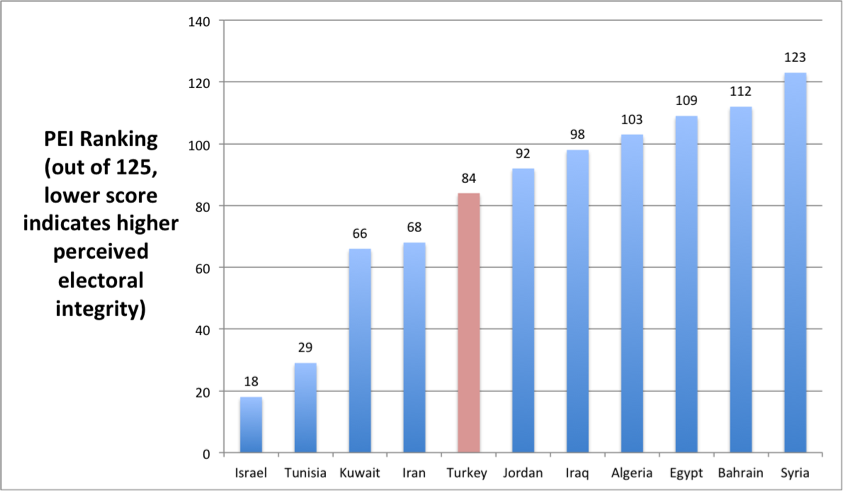


The June legislative elections scored particularly low in three key areas of the electoral process: electoral laws, campaign finance, and campaign media, all of which support the assessment that Turkey is on the path towards increased authoritarian tendencies.


Electoral Laws (21.97 / 100): Of the eleven dimensions of electoral integrity measured by the PEI, the legislative elections ranked the lowest with respect to integrity in electoral laws, 21.97. To put this in perspective, of the 153 discrete elections evaluated in the PEI, only ten elections have scored lower in this category (2).

In particular, Turkish electoral experts strongly agreed that electoral laws are unfair to small parties (4.91 on a 1-5 scale where 5 indicates strong agreement) and agreed that electoral laws favored the governing party (4.18). This evaluation comes as little surprise, given that Turkey has the highest, legislated electoral threshold in the world: political parties must obtain at least 10% of the vote to obtain a seat in parliament. Any parties that don’t clear this threshold are excluded from the parliament and the votes are considered “wasted votes”, which range anywhere from 3.71% of the total valid ballots cast as in the most recent election to a staggering 46.33% in the 2002 election.

As a result, the Grand National Assembly has been composed of a small number of parties compared to the total number of parties competing in the election. In the June election, twenty parties contested the election, with only four parties clearing the threshold, the highest number since 1999. One of these parties is the newly founded Peoples’ Democratic Party (HDP), a pro-Kurdish, leftist party that won 13.12% of the vote and 80 seats. While the threshold, effective since 1983 elections is ostensibly to provide government stability, it is widely viewed as a means of excluding the Kurdish minority from parliament. Given the current violence in the Kurdish regions, the HDP could potentially fall below the 10% threshold in the November elections, which could shift the current parliamentary deadlock and potentially give the AKP a clear majority of seats.

Campaign Media (27.61 / 100): The campaign media environment also scores low among the PEI experts (27.61), with concerns over the impartiality of coverage. In particular, expert strongly agree (4.54) that TV news favored the governing party and disagree (1.45) that parties had fair access to political broadcasts and advertising. These concerns were also noted by the Organization for Security and Co-operation in Europe in their election observation mission report, which highlighted media freedom as an area of “serious concern” as “media and journalists critical of the ruling party were subject to pressure and intimidation during the campaign” and state media was used in a partisan manner.

Campaign Finance (27.39 / 100): Overall PEI experts disagree that parties had equitable access to political donations (1.90), and strongly agree (4.82) that some state resources were improperly used for campaigning. Again, the OSCE reports notes that President Erdoğan attended numerous public events in an official capacity and used them as “opportunities to campaign in favour of the ruling party and to criticize opposition figures.” Additionally, state resources, such as state television, were used in violation of campaign finance rules.

As seen from the PEI data, Turkey already faces significant challenges in its perceived electoral integrity, particularly to the extent to which the ruling party is seen to be able to manipulate the elections to its favor through electoral laws, such as the threshold, pressure exerted on the media, and use of state resources for campaigns. While it is unlikely that any significant or legal changes will be made prior to the November elections, if citizens are to have any confidence in the outcome of this election and future elections, changes, either in the implementation of existing electoral laws or new ones, must be made.

(1) These levels are comparable to polling that occurred prior to the 2013 Gezi Park protests when distrust for the Parliament and government rose to 56 and 57% respectively.

(2) The countries with electoral laws perceived as lower than Turkey’s are: Turkmenistan (20.89), Bahrain (19.44), Djibouti (18.33), Tajikistan (16.25, 19.44), Malaysia (15.42), Belarus (13.69), Equatorial Guinea (13.33), Ethiopia (10.56), and Syria (9.38).

Electoral reform in Italy: strengthening electoral integrity?

By Dr. Marta Regalia

The issue of electoral reform has been the subject of repeated debate in Italy during recent decades. In most established democracies, major changes to the electoral system have occurred rarely as the status quo prevails among incumbent political parties. By contrast, as illustrated in table 1, Italy has seen four major electoral reforms since 1945 (D'Alimonte, 2005), with the latest passed in May 2015. One might also include the enactment and then the repeal of the Italian legge truffa (“swindle law”), but it never came into operation (Katz, 2005).

Major electoral reforms in Italy (1945–2015)


Table 1: Major electoral reforms in Italy (1945–2015)
Year of reform or debate
Year of first use
New (or proposed) system
1946
1946
PR with preferential voting within lists, national pool, and low threshold
1993
1994
MMM with partial compensation
1994–2001
Not passed
Various schemes to enhance majoritarian character of system
2005
2006
Bonus-adjusted PR
2007–09
Not passed
referendum to apply bonus to largest party rather than largest coalition
2015
2018
Majority-assuring semi-open list PR with eventual second round

Source: Adapted from Renwick (2010, 112) and Baldini (2011)

The first major reform, enacted in 1993, is a significant example of what Renwick (Renwick, 2010) calls elite–mass interaction: actually, a popular referendum played a prominent role. The PR system used since 1946 was identified as one of the main causes of political fragmentation, governmental immobility, the absence of alternation, corruption and clientelism. Electoral reform was then seen as able to contribute to lessening these problems (Donovan, 1995). The result was a mixed-member majoritarian system, which, however, was replaced in 2005 by a PR system with a majority bonus. This reform, an example of elite majority imposed reform, was driven by partisan considerations.

Following the electoral system established in 2005, in the Italian Chamber of Deputies (Camera dei Deputati) 630 members were elected through a closed-list proportional representation system. A pre-election coalition winning a plurality of votes was guaranteed 340 seats. The law had a series of thresholds designed to provide incentives for parties to enter coalitions, thus reducing party fragmentation. In the Senate (Senato della Repubblica), 315 members were elected through a closed-list proportional representation system but thresholds and premium are computed regionally, not nationally.

This system was used to elect lower and upper Chambers in 2006, 2008, and 2013. But it did not generate consensus since the new law was widely denounced immediately after the 2006 election and there were many attempts at further reform in subsequent years.

In December 2013, the Constitutional Court declared the 2005 electoral law unconstitutional for two main reasons: because it did not include a minimum threshold in order to attain the major­ity of seats, and because it had long, closed lists of candidates, so that selection was dominated by party leaders.

Understanding Italy's electoral performance

The immediate effect of the constitutional judgment was to accelerate electoral reform. In May 2015, a new electoral law was passed by parliament. The new proportional election system awards 340 out of 630 seats to any party (coalitions are not allowed) that wins more than 40% of the national vote (not just any plurality). If no party reaches that threshold, there is a second-round run-off between the two parties with the most votes. The electoral reform is expected to come into force in July 2016.

One way to understand this issue is to look at evidence of how independent experts evaluated the 2005 electoral system and comparable contests in post-industrial societies. The expert survey of Perceptions of Electoral Integrity (PEI 3-5) asks experts to evaluate elections using 49 indicators, grouped into eleven categories reflecting the whole electoral cycle. The dataset also includes a summary 100-point PEI Index based on summing all 49 indicators which provides one way to summarize the overall integrity of the election.

We can compare Italy’s performances in the PEI survey (Norris et al., 2015) with the mean of OECD member States. The results show that ranked Italy 21st out of 27 OECD countries, with an overall PEI Index of 67 on a 100-point scale. Italy is also second to last among West European countries.

Figure 1: Perceptions of Electoral Integrity Index in OECD member States


Source: Electoral Integrity Project. 2015. The expert survey of Perceptions of Electoral Integrity, Release 3.5 (PEI-3.5).

Note: Canada, France, Ireland, Luxembourg, Portugal, Spain and Switzerland are OECD member States not yet covered by PEI survey

To have a clearer understanding of the reasons why Italy performs so badly in the overall Perceptions of Electoral Integrity Index, the results can be broken down in more detai, as seen in figure 2.

Apart from boundary delimitation, all the other components of the electoral cycle show values below the OECD mean. The performance of Italy is mainly due to the electoral law[1]. According to the experts, the electoral law favoured the governing party, was unfair to smaller parties, and, above all, restricted citizens’ rights. This result is in line with the sentence of the Constitutional Court and with many of the major criticisms directed to the 2005 Italian electoral law. The long and closed lists of candidates provided party leaders with the power to select, in their “smoke-filled rooms,” the entire parliamentary class, disempowering the citizens. The PEI survey confirms this claim: experts evaluated the 2005 election law as restricting citizens’ rights[2].

Figure 2: Perceptions of Electoral Integrity components – Italy in respect to OECD mean


Source: Electoral Integrity Project. 2015. The expert survey of Perceptions of Electoral Integrity, Release 3.5 (PEI-3.5).

What about the future? Will the new reform strengthen electoral integrity?

Will the latest reform overcome some of the above-mentioned problems? The next general election will probably be in 2018. Supporters of the new law, called Italicum, claim that voters will now be able to choose their representative through preferential voting (open lists). By contrast, those who criticize the reform highlight the possibility of multiple candidacies in up to 10 districts which will significantly distort the relationship between voters and candidates (Regalia, 2015). Moreover, the majority bonus threshold of 40% will assign the majority of seats to the party collecting the biggest share of votes. It will put this party in the position to elect the President of the Republic on the fourth round of voting (when the absolute majority is sufficient), and to choose all five Constitutional judges and several components of the Higher Judiciary Council. Whether these spill-over effects will affect the integrity of future elections is a matter of opinion.

There is just one point everyone agrees upon: in Italy the electoral law will remain an object of intense and acrimonious debate, thus hindering both electoral integrity and the quality of the Italian democracy.


References

Baldini, G. 2011. The Different Trajectories of Italian

Electoral Reforms. West European Politics, 34, 644–663.

D'Alimonte, R. 2005. Italy: a Case of Fragmented Bipolarism. In: Gallagher, M. & Mitchell, P. (eds.) The Politics of Electoral Systems. Oxford: Oxford University Press.

Donovan, M. 1995. The Politics of Electoral Reform in Italy. International Political Science Review, 16, 47-64.

Katz, R. 2005. Why Are There So Many (or So Few) Electoral Reforms? In: Gallagher  M. & Mitchell, P. (eds.) The politics of electoral reforms. Oxford: Oxford University Press.

Norris, P., Martínez i Coma, F., Nai, A. & Grömping, M. 2015. The expert survey of Perceptions of Electoral Integrity, Release 3.5, (PEI_3.5). In: www.electoralintegrityproject.com (ed.).

Regalia, M. 2015. Electoral Systems. In: Jones, E. & Pasquino, G. (eds.) Oxford Handbook of Italian Politics. Oxford: Oxfrod University Press.

Renwick, A. 2010. The Politics of Electoral Reform. Changing the rules of democracy, New York, Cambridge University Press.

Notes

[1] This difference of means is statistically significant at the 0.01 level in a 2-tailed independent sample t-test.

[2] This difference of means is statistically significant at the 0.01 level in a 2-tailed independent sample t-test.

Monday, 10 August 2015

Mexico faces decline in electoral integrity

By Miguel Angel Lara Otaola
(Visiting fellow Electoral Integrity Project, University of Sydney)


Historically Mexico has long experienced controversies over problems of electoral integrity, including malpractices of vote-buying and intimidation (Magaloni 2006, 2010; McCann, J. A., and Jorge I. Dominguez, 1998). The most serious issues, which, amongst other factors, guaranteed the PRI’s predominance, were thought to have been corrected during recent decades, although at the same time problems of narco-crime’s involvement in politics have resurfaced and the 2012 Presidential elections saw some street protests over allegations of voter corruption.

In the light of this history, on January 2014, Mexico’s Congress approved far reaching political and electoral reforms. This involved many constitutional changes and a new Electoral Code. Amongst other things, it allowed having coalition governments, increased checks on the President, expanded voting rights for citizens living abroad, and included special provisions for achieving gender parity in Congress. Moreover, it introduced the participation of independent candidates and allowed the re-election of law makers. 

The electoral reform enacted substantial changes. First, the Federal Electoral Institute (IFE) was transformed into a National Electoral Institute (INE). This new institution is in charge of organising federal elections (for the Presidency and Congress) and local elections (in coordination with 32 existing state election commissions). As a national body, it is now in charge of overseeing political party finance at the national level and of appointing the members of the country’s local election commissions. Furthermore, the reform changed the structure of INE’s Council (by adding two Councillors), strengthened its auditing powers, and increased sanctions for violations to the election code, including more provisions for the annulment of an election. In short, all these represented a significant evolution of Mexico’s electoral system.

The main stated aim of this change was to improve election integrity, especially confidence in electoral processes. In particular, as argued by its makers, the change from IFE to INE would bring local elections up to the internationally recognised standards of federal elections. Lorenzo Córdova, President of INE said that the reform sought to strengthen elections in all states. 

Yet it is unclear whether the reform will achieve its goals. In particular, data from expert Perceptions of Electoral Integrity (PEI) shows that in the 2012 Presidential election the country’s integrity score was 62 out of 100 points. By contrast, after the changes were implemented, in the 2015 legislative election, the score was 52. This is a modest but statistically significant drop in expert evaluations (R. .33, N. 34, P=.056). Moreover, this was not simply the difference between the types of contest, since legislative elections are usually evaluated slightly more highly by PEI experts than executive contests. 

In terms of relative global position, out of 153 elections evaluated between 2012 and 2015, this meant that Mexico dropped from position 55 to 95. This score is obtained from experts that monitor the quality of an election based on 49 indicators covering 11 components of the electoral cycle (from election laws and voter registration to election results). 

At the country level, Mexico ranks 54th of 125 and obtains a score of 57, which places it in the middle of the Latin American and Caribbean region (See Figure 1). Outside the region, countries with similar scores are India, Serbia, Ghana, Indonesia and Hungary. States such as Tunisia, Mongolia, Lesotho and South Africa -with their substantial challenges in electoral infrastructure- fare better than Mexico. 

Specifically, if we deal with the eleven components of the index, all but one (election results) have slightly decreased for Mexico. Out of these, however, only the drop in voting processes is statistically significant (P=.000) while the drops in voter registration, campaign media and vote count are significant but only at a 10% threshold. By contrast, evaluations of electoral results improved, largely due to the fact that the 2015 elections were perceived as being less challenged and having generated fewer protests. Figure 2 below shows the PEI score changes for all the parts of the electoral cycle. 


Figure 1. Electoral Integrity in Latin America and the Caribbean.


Figure 2. Changes in Electoral Integrity. Mexico, 2012-2015.

The overall drop must not be considered a direct effect of the recent political and electoral reform as many other factors may be at play. As several scholars have noted (Barreda and Ruiz Rodriguez, 2013; Birch, 2008), the general performance of the government can affect trust in other institutions, such as electoral processes. And these past two years have not been especially rosy for Mexico. To start with, on September 2014 a group of 43 people from the Ayotzinapa Teachers Training School were attacked and disappeared by municipal police, never to be heard from again. Soon after, a scandal erupted surrounding the buying of a multi-million-dollar house by the country’s first lady. Many other similar events have followed. And, if this was not enough, in July 2015 the top drug lord leader in the country Joaquin “El Chapo” Guzmán escaped (for the second time) from a high security prison. 

As a result, support for the political system has suffered greatly. According to the PEI experts, in the last three years confidence in the government, the parliament and the courts has dropped. Out of these, the drop in confidence in government is the only statistically significant (P=.054). While in 2012 confidence in the government was the highest amongst the three institutions (5.14 points on a 1 to 10 scale), in 2015 it was the lowest (3.8 points). Moreover, when tested further, confidence in government among Mexican experts were strongly and significantly related to Perceptions of Electoral Integrity, even after controlling for several other factors, such as the expert’s background (age, sex, education, and whether they are based in the country or international).

Elections are about technical accuracy – but also about broader perceptions and beliefs. Elections do not happen in a vacuum but they are embedded in a wider political system. A ´below average´ election organised in a country with a stable and legitimate political system has much more chances of being seen as credible than a technically perfect election in a country with a fragile –or momentarily weakened– political system. Let us hope that the storm Mexico is living passes swiftly. 

References

Barreda, M. and Ruiz Rodriguez, L. (2013) ‘La cadena causal de la confianza en los organismos electorales de América Latina: sus determinantes y su impacto sobre la calidad de la democracia’, Revista De Ciencia Política (Santiago), 33 (3), 649-673.

Birch, S. (2008). ‘Electoral institutions and popular confidence in electoral processes: A cross-national analysis’, Electoral studies, 27 (2), 305-320.

Magaloni, Beatriz. 2006. Voting for Autocracy: Hegemonic Party Survival and Its Demise in Mexico. Cambridge: Cambridge University Press.

McCann, J. A., and Jorge I. Dominguez. 1998. ‘Mexicans react to electoral fraud and political corruption: An assessment of public opinion and voting behavior.’ Electoral Studies 17, (4): 483‐503

Norris, Pippa; Martinez i Coma, Ferran; Gromping, Max; Nai, Alessandro, 2015, "Perceptions of Electoral Integrity, Version 3.5", http://dx.doi.org/10.7910/DVN/UO9ABD, Harvard Dataverse, V1

Schedler, Andreas. 2012. The Politics of Uncertainty Sustaining and Subverting Electoral Authoritarianism. CIDE: Mexico City.

Friday, 7 August 2015

The Year in Elections, mid-2015 update (PEI 3.5)

The latest version of the Perceptions of Electoral Integrity (PEI) Index has been released. This last version (3.5) includes the responses for 1696 experts for 153 elections in 125 countries. The data can be downloaded free of charge here. It is available at the expert, election and country level, and adds to the previous releases (3.0, 2.5, 2 and 1).

In this post, we present some interesting results for the 27 elections in 18 countries considered during the first half of this year. Before, though, we would like to thank all the experts that have devoted their time and knowledge answering our questionnaire. We define an expert as a political scientist (or social scientist in a related discipline) who has published on (or who has other demonstrated knowledge of) the electoral process in a particular country. Specifically, demonstrated knowledge is defined by the following criteria: (1) membership of a relevant research group, professional network, or organized section of such a group; (2) existing publications on electoral or other country-specific topics in books, academic journals, or conference papers; and (3) employment at a university or college as a teacher. At least forty experts per country were contacted for each election, including both domestic and international experts. The domestic/international distinction was made based on institutional affiliation, citizenship, and country of residence.

The elections included in this release took place between 1 January and 30 June 2015. They are the legislative elections of Uzbekistan, Greece, Comoros, Lesotho, Estonia, Tajikistan, El Salvador, Micronesia, Israel, Nigeria, Finland, Benin, United Kingdom, Guyana, Ethiopia, Suriname, Mexico, Turkey and Denmark and the presidential contests of Sri Lanka, Croatia, Zambia, Uzbekistan, Sudan, Togo, Kazakhstan and Poland. You can access the new executive summary EIP report here.

How was the integrity of those contests assessed by the PEI experts? We ask experts to evaluate elections using 49 indicators, grouped into eleven categories reflecting the whole electoral cycle. The dataset also includes a summary 100-point PEI Index based on summing all 49 indicators. These are the results for the overall PEI Index:


Finnish, Danish and Estonian elections perform very well in the ranking, well above the average (55.8). Perhaps, one of the most surprising results is the performance of the United Kingdom very similar to Benin’s. Another African country, Lesotho, performs above average.

There are two regions that seem to concentrate the worst performers of the elections: sub-Saharan Africa and former soviet republics. Indeed, Ethiopia, Togo and Sudan, jointly with Tajikistan and Uzbekistan perform very low in the index. Ethiopia’s performance, unfortunately, becomes the lowest of the series (disbanking 2013’s Equatorial Guinea). Obviously, democracy and development levels may have an impact on the performance but as the cases of Lesotho and Benin show, nothing is written in stone and the integrity of the elections can be improved.

Two big countries - Mexico and Turkey - perform below the average and worse than in previous years. Mexico loses about 10 points compared to the presidential elections of 2012, while Turkey looses about 4. It is also worth to mention that experts differentiate among the quality of elections within the same countries in the same year. A look to the evaluations of the Uzbeks Presidential and Legislative elections are a clear indication of this. While in neither any of the elections reaches the average, the Presidential (49) elections were substantively better evaluated than the legislative (39).

Obviously, this is just a first cut of the results, descriptive statistics without looking for any causal relation. In forthcoming posts we will show other results of the data. For the moment, you can download the data here and use it for your own research.

By the end of 2015, we will have gathered more than 175 elections and about 150. Keep posted for the new posts and updates. If you have any query, doubt or spot any inconsistency in the data, please do not hesitate to contact us at electoralintegrity@sydney.edu.au.


Dr. Ferran Martinez i Coma
Sydney, 8 August 2015

Thursday, 16 July 2015

Cleaning up politics

By Pippa Norris, Andrea Abel van Es and Lisa Fennis 

This blog post appeared on the Washington Post's Money Cage on July 16 at 3:02 PM


The degree of state regulation of political finance around the world, from less (yellow) to more (red)

The role of money in politics challenges states worldwide, both rich and poor. Its abuse raises problems of graft, corruption and cronyism, which undermine legitimacy and governance. In recent years, financial scandals have erupted all over the world. In Britain, a Conservative Party treasurer offered access to the prime minister for 250,000 pounds. In Germany, corruption hit during the final years of Chancellor Helmut Kohl. In Brazil, high-profile politicians made clandestine payments in exchange for support. In Australia, members of the prime minister’s Liberal party stepped down after soliciting illegal donations. In Chile, recent corruption allegations rocked the political establishment.

Yet money is essential for mobilizing election campaigns, sustaining political party organizations, and communicating with citizens. And countries, such as Sweden, have managed to avoid falling foul of malfeasance and graft.

So how can politics be cleaned up most effectively? New evidence on this issue is available from a comparative report and dataset released by the Money, Politics and Transparency project, produced by Global Integrity (GI), the Sunlight Foundation, and the Electoral Integrity Project (EIP) at Harvard University and the University of Sydney.

Election experts worldwide argue that political finance is one of the key problems faced by political parties and candidates during election campaigns, and ineffective regulations damage electoral integrity worldwide. The report compares how this problem is tackled in emerging economies as diverse as India, Mexico, South Africa and Russia, as well as in established democracies, such as Britain, Japan, Sweden and the United States.

The Money, Politics and Transparency project investigated three crucial questions: How do states around the world attempt to regulate the role of money in politics? What triggers landmark reforms? And, what ‘works’, what fails and why?

The project Web site presents evidence from its Political Finance Indicators, comparing over 50 countries worldwide. A new downloadable report on Checkbook Elections describes detailed case studies of campaign finance reforms in states from all regions of the world.

How do states regulate money in politics?

Policies regulating the role of money in politics include disclosure requirements, contribution limits, spending caps and public subsidies. In most cases, these strategies are combined.


States range across the spectrum from laissez-faire to comprehensive regulation. Transparency rules reflect a minimal role for the state. Contribution and spending limits intervene more directly to provide more equitable party competition and to limit the risks of corruption. Public funding, directly reliant on the state, is the strongest single form of state intervention. A combination of all regulatory policies reflects maximum state regulation.

Data from International IDEA shows that countries such as South Africa, Sweden and India have more laissez-faire policies, while Brazil, Indonesia and Russia are more interventionist. But more legal control is not necessarily better. The results are mixed. For example, Japanese reforms during the early 1990s successfully cut election costs and expanded political competition. But Russia’s tight political finance laws entrenched electoral authoritarianism. And South Africa’s lax political finance laws have entrenched ANC predominance.

The map at the top of this post shows the degree of state regulation of political finance around the world. Countries with more laws on the books are not necessarily closer to achieving a level playing field in party competition, more transparency or less corruption. The reasons become evident if we compare several typical types of reforms.

Transparency requirements are among the most common reforms of the last decade. But disclosure rules are often inconsistently applied. Global Integrity used experts to to construct their Political Finance Indices covering 54 countries worldwide. The results suggest that eight out of 10 countries have statutes requiring parties and/or candidates to submit contribution and expenditure reports. Yet in reality this rarely happens during campaign periods, and the public is unable to access much of the information reported to oversight authorities.

Restrictions on contributions and expenditures are often undermined by loopholes. For example, laws often limit the amount an individual can donate directly to a political party or to a candidate, but not both. Similar loopholes in regard to anonymous and corporate donations are common, and spending limits also fail in many cases. Moreover, few countries regulate election spending by nonprofits, unions, and independent groups, where this is regarded as a private activity in civil society.

Finally, states have adopted public funding and subsidy laws to reduce dependence upon private sector donors and the dwindling band of party members. In practice, however, funds can be unfairly allocated

What ‘works’ and why?

Effective laws depend upon enforcement capabilities, political will, and autonomous oversight agencies. Unfortunately oversight bodies are often hamstrung through a lack of merit-based appointments, independent leadership, technical capacity, and lack of authority. Partisan appointments, insufficient staff and budget, and/or a lack of substantive legal power hinder oversight bodies in countries as diverse as the United States, Romania, Nigeria and Russia.

No single policy can control money in politics. For instance, public funding without spending or contribution limits can lead to a campaign finance arms race. Disclosure requirements without spending caps or equitable public funding may erode public trust in the electoral process. It is more effective to use a balanced mix of regulations fitting each country.

Policies often require trade-offs between values, such as the importance of freedom of expression vs. a level playing field for all parties.

Lax regulation can lead to skyrocketing campaign costs, corruption, cronyism and winner-take-all politics. Yet excessive regulation can lead to loophole seeking and entrenched elites.

More information, including the report Checkbook Elections, detailed case studies and the Political Finance Indicators, is available at moneypoliticstransparency.org.

Wednesday, 15 July 2015

Detecting and deterring electoral fraud and malpractices in Africa

Tuesday, 30 June 2015
By Ferran Martínez i Coma
Tuesday, 30 June 2015

Following the launch of EIP’s report Electoral Integrity in Africa, the Hanns Seidel Foundation's Conference on Electoral Integrity in Africa kicked off with a two-day day program focusing on the role of political parties in detecting and deterring electoral fraud and malpractice in Africa.
The program and presentations were of very high quality, and hold many valuable insights For those working in this field. This piece intends to capture a few of the key arguments and lessons.

After the introductory remarks by Graham Hopwood from the Institute for Public Policy Research in Namibia, Dr Brigalia Bam, former Chairperson of the South Africa’s Independent Electoral Commission, and Professor Jørgen Elklit, from Aarhus University, took the floor for the first presentation of the day. They presented on the role of political parties in promoting electoral integrity in Africa. Bam’s key message was that that electoral fraud should not be seen as an exceptionally African phenomenon, but that measures to detect and deter it should be informed by context-specific variables. She also spoke about the impact of electoral observer missions, and argued that missions could be better understood if there was room for reciprocity, primarily between those operating in African states and their Western counterparts. 
Professor Elkit departed from this premise, arguing that we cannot expect political parties to contribute or promote electoral integrity. In his view parties, in the end, are organisations trying to maximize power. Hence in order to assure that parties promote electoral integrity, it must be establishing structures that make it in their own best interest. Elklit concluded by proposing measures that would allow parties to teach members, supporters, party agents and the public to behave in an orderly way and cooperate with the Election Mission Bodies.

Day one: Unpacking electoral integrity in Southern Africa

Following these presentations the remainder of the day was dedicated to presentations with a country-specific focus on Southern Africa:
  • Dr. Collette Schulz‐Herzenberg presented preliminary data from the Comparative National Elections Projects. These meshed well with the conclusion of EIP’s edited volume Advancing Electoral Integrity: citizens tend to be more likely to perceive a greater supply of democracy and express satisfaction with the way democracy is working when they consider the elections to be free and fair, and electoral institutions to be trustworthy.
  • Miguel de Brito from EISA subsequently explained why Mozambique performs so badly when holding elections. As is illustrated in EIP’s report Electoral Integrity in Africa, de Brito observed that in Mozambique, some malpractice is systemic and systematic while other is individual and opportunistic. He explained that initiatives to improve such situation should include a combination of education, unequivocal enforcement of the law, and punishment / penalties. Moreover improved monitoring by political parties, media and citizens alike would also help uncover and draw attention to both systemic and opportunistic malpractice and fraud. 
  • Graham Hopwood spoke about the last elections in Namibia, which was its first national political contest using electronic voting machines. Though victory was accepted and the electoral process was not questioned, some major problems and deficiencies. These include long queues – the the hours spent in line proved an obstacle for many, particularly for women with children. Morover the polling stations inconsistently adhered to the 21:00 closure rule, meaning that in some cases people who had been queuing were allowed to cast their vote, while others were not. To add insult to injury, it has been reported that in various locations mobile polling stations never arrived or arrived late.
  • Dr. Neo Simutanyi from the Center for Policy Dialogue explained that Zambia’s elections have been controversial since 2001, and that electoral fraud and malpractices have dominated Zambia’s political discourse. Examples of irregularities include the State’s use of patronage resources (vote-buying), buying of voter’s cards to disenfranchise voters, and unusually large number of invalid or spoilt votes in opposition areas. 
  • Tom Wolf, representing IPSOS in Kenya, presented his work on the circumstances in which an incumbent elite is prepared to ‘lose’ an election and give up power. He argued that in calculating the costs or benefits of refusing to ‘lose’, incumbent elites consider various factors, such as the degree to which pre-election manipulation and/or electoral fraud can be concealed, the likelihood of violent protests or external/donor ‘punishment’, the likelihood of suffering inacceptable individual punishment, and the likelihood of the new government pursuing ‘misguided’ policies if a fair election results in defeat.
  • Kizito Tenthani from the Centre for Multiparty Democracy in Malawi gave a detailed assessment of Malawi’s state of democracy, covering matters ranging from the current political situation in Malawi to the role and performance of the electoral commission, its administration, the elections, its results and the management of such results.
  • In the afternoon, I had the pleasure of chairing the session in which Olufunto Akinduro from EISA, spoke about the electoral process in Nigeria. Providing an overview about the electoral process in the latest elections, she noted that five elections have been held in Nigeria since 1999. The 1999 election was acceptable, whereas the 2003 contest was not credible, and 2007 saw the worst election to date. This election acted as a turning point, leading to the ERC and constitution amendment aimed at increasing integrity in the 2011 elections. The 2015 election was the most competitive in Nigeria’s history, with the exception of the controversial 1983 elections.
  • Then, the floor was for Dr. Motlamelle Kapa from the University of Lesotho who noted that in 2001, the MMP system was adopted expanding the inclusiveness of parliament and a virtual elimination of claims of fraud and that all parties have relatively equitable access to state resources like state-owned media and party and campaign funding. 
  • Finally, Professor Sheila Bunwaree from University of Mauritius talked about a necessary holistic approach in addressing fraud and malpractice. Moreover, she mentioned that although there have been nine general elections since independence, the last 2014 general election revived the debate on the ‘funding of political parties’, which remains shrouded in opacity. 
Day two: A broader discussion on electoral integrity in Africa

The second day, the conference moved onto more general issues related to electoral integrity. 
In the first session we covered electoral violence and conflict management panels.
  • Gareth Newham, representing ISS, showed different maps on patterns of electoral violence in South Africa. He showed that during the 2013-2014 period, 7% of all protests were election related (153 events), of which 63% were violent. 29% of all election protests were in Gauteng, 22% in the Western Cape and 16% in the Eastern Cape. 63% took place in metro areas, 19% in urban areas and 18% in rural areas. The 2014 elections proved that protest hotspots are not always predictable: they develop over time and initial triggers vary widely.
  • Ilona Tip, from EISA, spoke about conflict management practices. She mentioned that her organization has learnt a number of lessons, including that working closely with the EMB builds trust, the importance of adequate training; and the need for agreement of mediators by stakeholders. She concluded that any mechanism for preventing, managing and resolving election conflict can only be effectively implemented if there is agreement on the rules of the game. 
  • Professor Shaheen Mozaffar, from Bridgewater State University, explained that elections magnify existing conflicts unrelated to elections, for example the land issues prevalent in Cote-d’Ivoire, Kenya and Zimbabwe. Such violence takes the form of short-term episodes directly related to election events, but may have long-term consequences, which is why it is an important focus of analysis and policy intervention. He also stressed a paradox: in essence, elections are organized uncertainties because their outcomes cannot and should not be known ex ante. The paradox is that substantive uncertainty requires procedural certainty. It is this paradox that defines the central task of electoral governance: organizing electoral uncertainty by providing institutional certainty. As a way forward, Professor Mozaffar suggested to incorporate the EIP framework and insights presented in Electoral Integrity in Africa into future analysis, assessments and policy designs. 
  • Finally, Professor Jørgen Elklit, having served the Kiegler Commission, spoke about his impressions about the outbreak of electoral violence in Kenya. He witnessed firsthand the poor quality of the voting register. Whilst many new voters were registered during 2006 and 2007, more than 25% of the voting age population were not registered, and women and youth were particularly under-registered. Also, many deceased voters (close to 1 million) remained on the voters’ roll and many of them were shown to have voted. Moreover, there were various inconsistencies, and when malpractice and misunderstandings are perceived as rigging, this can result in violence. 
The topic of the second session was on ballot fraud and party agents.
  • Ebrahim Fakir, representing EISA, exposed some recent incidents of electoral fraud in South Africa such as irregular registration in a municipal by-election in Abaqulusi, in northern KwaZulu-Natal; the use of false addresses in Potchefstroom (Tlokwe); and the use of marked ballot boxes filled with ballot papers in Alexandra township.
  • Miguel de Brito, also from EISA, explained that in Mozambique party agents are potentially the most important oversight element in the electoral process, depending on their numbers, powers and access. However, their impact is limited by lack of quality, training, resources, support and commitment. 
  • Naita Hishoono, from the Namibia Institute of Democracy, presented the results of a survey that administered on the 16 political parties that participated and experienced the 2014 election in Namibia. Although some parties did not offer any feedback, a common complaint was the need to clearly delineate the roles of poling staff and police officers on duty at the polling stations. 
  • Tom Mboya, from the Democratic Congress in Kenya, explained how the country has experienced two questionable elections in a row. During both contests, administered by two different EMBs, voting went well, only for the process to collapse at the tallying stage. He emphasised that the recruitment and training of party agents is critical to ensuring the integrity of vote. He also noted that party die-hards and sycophants are not necessarily the answer, but that it is important to invest in party agents and institutionalize their role.
The final session of the day focused on electoral disputes and multi-party liaison committees.
  • MP Haniff Hoosen, from the Democratic Alliance in South Africa, presented his views as he noted that free and fair elections are not an event, but a process leading up to the event. He emphasised that the role of the IEC is key to this. He explained that in his experience, an electoral commission can only function as an institution that facilitates the provisions of democratic systems if it provides the leadership and direction that commands citizens’ respect and trust. It’s alternative is to be reduced to a mere administrative tool on Election Day.
  • Libolly Haufiku, from the Rally for Democracy and Progress in Namibia gave a presentation on his experience on the role of the judiciary. 
  •  This last session was closed with the research on Ghana by Halfdan Lynge-Mangueira from Oxford University. He noted that according to the literature, challenging an African election in court makes little sense, as it is an expensive and time-consuming avenue with few benefits. Although it is very rare for a judiciary to overturn an election, there are examples where this has happened (Kenya 2013, Ghana 2012 and Nigeria 2011). Halfdan’s research looks at the content of such challenges. In total there have been 26 challenges (5% of all elections) parliamentary elections in Ghana go to court. His analysis shows that the probability that elections are challenged is higher when won by an NDC candidate (1.2%-point – recall that only 5% of all elections are challenged); and that the probability that elections are challenged is higher when win-margins are small. In his view, one of the secrets to Ghana’s success is the high level of competition between well-organized parties, decentralization, and delegation of responsibility to the party agents.
Overall, the conference proved to be informative and productive. We will continue collaborating with our African colleagues and with HSF.

Tuesday, 30 June 2015

New report: Electoral integrity in Africa


Since its launch in 2012, the Electoral Integrity Project has studied electoral integrity around the world, considering such notions as why electoral integrity matters, why elections fail, and what can be done to address these problems.

A regional focus on Africa

EIP's research programme on Perception of Elections Integrity (PEI) is an ongoing initiative which does not only allow a comparison between countries, but over time will enable us to compare consecutive elections within countries as well as identifying regional trends. Providing an in-depth analysis of recent elections in 28 African countries, this is EIP's first report that presents findings of the study of electoral integrity in a specific region. A continent of great diversity, African elections are under-studied in comparison with Europe or America.

The Hanns Seidel Foundation, a German non-profit organization promoting democracy, good governance and the rule of law across the African continent,  commissioned the report, which was launched in Cape Town on 22 June 2015 by EIP's Ferran Martínez i Coma and Judge Johann Kriegler, former Constitutional Court Judge of the South African Constitutional Court.

The Foundation has welcomed the report, and the PEI index on which the findings are based. Noting that "it is currently the best rating tool available", the Foundation recognises that this is the first attempt to measure electoral integrity across the African continent, and hopes it will stimulate the debate on the integrity of political contests across Africa.

During 2015, Zambia, Nigeria, Togo, Benin, Burundi and Burkina Faso, among others, have voted or are expected to do so. The integrity of the elections is crucial, not only for normative reasons, but for instrumental factors, such as the internal stability of the country, and citizens’ satisfaction with their regimes. We are currently gathering data on those contests and hopefully this will be the first of many reports to come.

Purpose of the report

The purpose of this report is twofold. First, to present the African results of the Perceptions of Electoral Integrity expert surveys, and then to analyse important elements at play in shaping the integrity of African elections. Much attention has been placed on polling day and the immediate administration of elections, but Ferran Martínez i Coma and Max Grömping show that many other elements of the electoral cycle are key to the integrity of the elections. 

Eight main findings:

  1. The degree of threats to electoral integrity is more severe in Africa when compared to the rest of the world.
  2. The types of problems in Africa are similar to those found in the rest of the world. Put simply, there is no African electoral exceptionalism.
  3. The report highlights the fact that elections can fail long before election day, so attention should be paid to the electoral dynamics and institutional quality over the entire election cycle not just election day.
  4. State resources for elections are important, but not determinant.
  5. Difficulties in regulating campaign finance extend across the continent.
  6. The vote count is consistently the highest rated part of the election cycle.
  7. Countries with good overall electoral integrity may still perform poorly in certain dimensions of the electoral cycle, on the other hand, low overall performers may excel in certain dimensions.
  8. Two country case studies of Malawi and Mozambique highlight that countries with similar levels of economic development can have vastly different outcomes of electoral integrity.

Download the report